
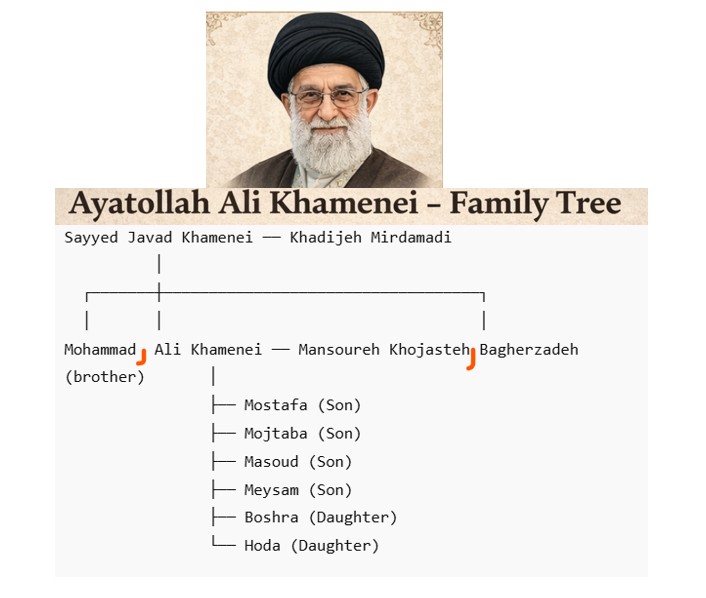
Ayatollah Sayyid Ali Hosseini Khamenei has led Iran as Supreme Leader since 1989, shaping Iranian politics for more than three decades. While his political life is well documented, his family background and lineage are rooted in religious scholarship, clerical tradition, and generations of devotion to Shia Islam.
This article presents a comprehensive family tree and family history of Ayatollah Khamenei based on verified sources.
Early Life & Family Background
Ali Khamenei was born on 19 April 1939 in Mashhad, Iran — an important religious center for Shia Muslims. He grew up in a clerical family with strong ties to Islamic scholarship and leadership. Wikipedia
Parents
-
Father: Sayyed Javad Khamenei — A respected Islamic scholar (alim) associated with religious education and leadership in Mashhad. Wikipedia
-
Mother: Khadijeh Mirdamadi — Daughter of a cleric (Sayyed Hashim Mirdamadi), representing a family lineage connected to religious learning. Islamic Laws
Ali Khamenei was the second of eight children born to his parents. Wikipedia
Ancestry & Religious Lineage
The Khamenei family belongs to the Azeri Sayyid class, claiming descent from Imam Ali Zayn al-Abidin and ultimately from the Prophet Muhammad (PBUH). This heritage gives the family the honorific title “Sayyid,” indicating lineal descent from the Prophet’s family. Wikipedia
Siblings of Ayatollah Khamenei
Ali Khamenei has several siblings, among whom the most publicly known are:
-
Mohammad Khamenei — Cleric, politician, and professor, older brother of Ali Khamenei. Wikipedia
-
Hadi Khamenei — Younger brother, also a cleric and public figure. Wikipedia
-
Fatemeh Hosseini Khamenei (deceased) — Elder sister, who passed away in 2015. Wikipedia
The family background reflects a deep tradition of religious education and service in Iranian society.
Marriage & Immediate Family
Spouse
Ali Khamenei is married to Mansoureh Khojasteh Bagherzadeh, born in Mashhad into a religious family. They married in 1965 after meeting privately the previous year. Mansoureh has served as the spouse of the Supreme Leader since 1989 and earlier as the spouse of the President of Iran (when Ali Khamenei was president from 1981 to 1989). Wikipedia
Children of Ayatollah Ali Khamenei
Ayatollah Khamenei and Mansoureh Khojasteh Bagherzadeh have six children: four sons and two daughters. Islamic Info Center+1
Here is a verified overview:
Sons
-
Mostafa Khamenei (born 5 Feb 1965) — The eldest son, educated in religious studies, married into a clerical family. Islamic Info Center
-
Mojtaba Hosseini Khamenei (born 8 Sep 1969) — His second son, involved in political and religious spheres; married Zahra Haddad-Adel (daughter of a prominent conservative politician). Islamic Info Center+1
-
Masoud (Mohsen) Khamenei (born 15 Mar 1972) — A cleric and scholar involved in managing and publishing his father’s works; married into another clerical family. Islamic Info Center
-
Meysam (Meitham) Khamenei (born circa 1977) — The youngest son, also involved in clerical activities and maintaining aspects of his father’s legacy. Islamic Info Center
Daughters
-
Boshra Khamenei — One of his daughters, married into academic or clerical circles. Islamic Info Center
-
Hoda Khamenei — The other daughter, keeping a private public profile. Islamic Info Center
Family Influence on His Leadership
Ayatollah Khamenei’s upbringing in a religious and scholarly household played a central role in shaping his worldview and leadership style. His early education in traditional Islamic schools and later advanced studies in the seminary of Qom positioned him as a major figure in the Iranian Revolution of 1979 and subsequent political evolution of the Islamic Republic. Wikipedia
His close ties to clerical networks and the broader seminary establishment provided both theological legitimacy and political foundation for his rise from a young revolutionary figure to supreme leadership. Encyclopedia Britannica
Why His Family History Matters
-
Religious Legacy: The Khamenei family’s clerical heritage reflects long-standing traditions in Shia scholarship. Wikipedia
-
Political Influence: Members of his family, particularly his sons and brothers, are integrated into Iran’s religious and political structures. Islamic Info Center
-
Cultural Identity: The claim to descent from the Prophet Muhammad (through Sayyid lineage) is a significant aspect of cultural and religious identity in Shia Islam. Wikipedia
- Android: Family Root App on Google Play
- iOS: Family Root App on Apple Store
📜 Disclaimer
The family tree and biographical information provided in this article are based on publicly available sources and records. While we strive for accuracy, we do not guarantee the completeness or authenticity of the data. This content is intended for educational and informational purposes only and does not aim to infringe on any individual's privacy or personal rights. If you believe any information is incorrect or wish to request edits or removal, please contact us at Info@familyrootapp.com.