
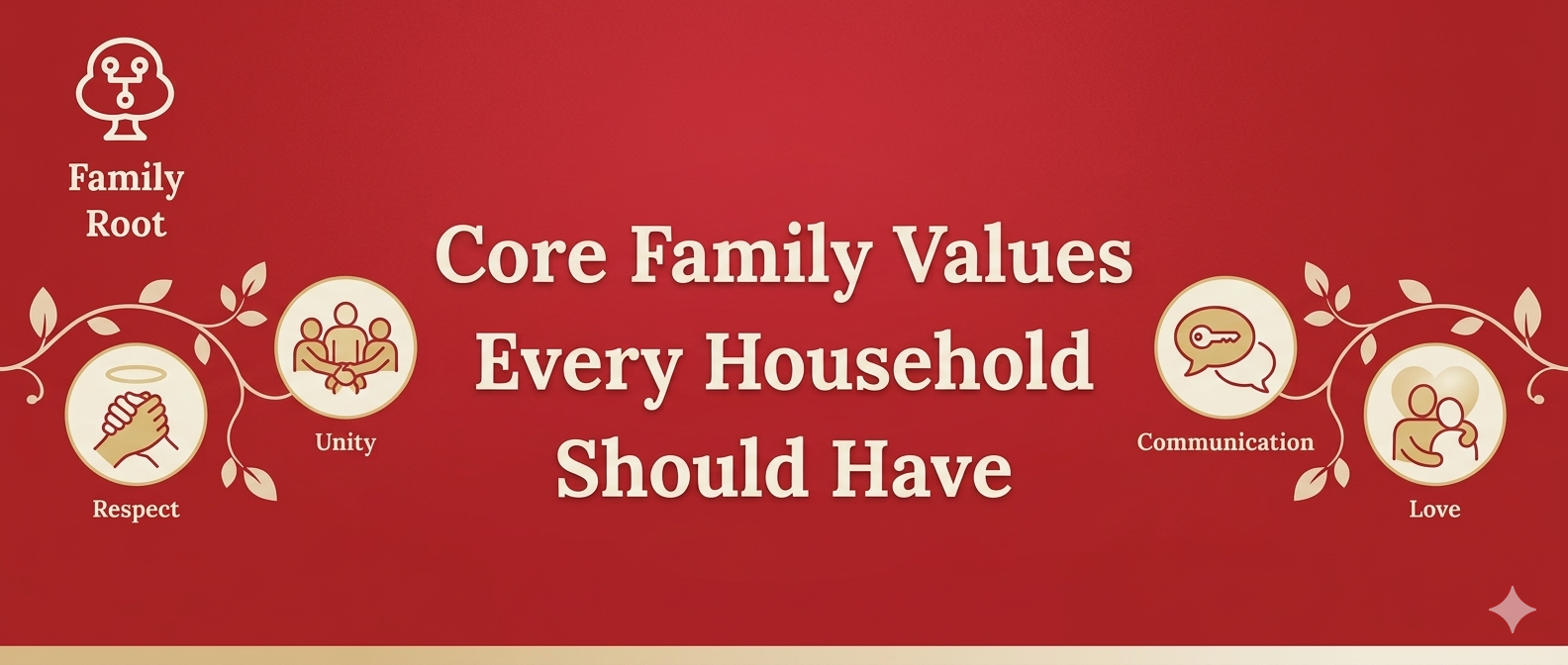
Every family is unique — different in culture, background, structure, and story. But behind the world's happiest and most resilient families lies a common thread: a shared set of values that guide how they treat one another, face challenges, and grow together. Family values are not rules posted on a wall. They are the invisible heartbeat of a home — shaping every decision, every conversation, and every memory made under one roof.
Whether your family is just starting out or you're looking to strengthen bonds that already exist, this guide walks you through the core values that every household should cultivate.
1. Respect — The Foundation of Every Relationship
Respect is the cornerstone of a healthy family. It means treating every member — from the youngest child to the oldest grandparent — with dignity, patience, and genuine consideration. Respect is not demanded; it is modelled. When children see parents speak to each other with kindness and listen without interrupting, they absorb that behaviour as their own standard.
Practical ways to nurture respect at home:
- Use "please" and "thank you" consistently, even with young children
- Allow everyone to finish speaking before responding
- Acknowledge different opinions without dismissing them
- Knock before entering a room — small gestures carry big meaning
Families built on mutual respect experience fewer unnecessary conflicts and recover more quickly when disagreements do arise.
2. Open Communication — Where Understanding Begins
Silence might keep the peace in the short term, but open communication builds lasting connection. Families that talk openly — about feelings, worries, dreams, and even mistakes — create an environment where every member feels safe and valued.
Good communication is not about talking more; it is about talking better. This means being honest without being hurtful, listening without judgement, and making space for difficult conversations rather than avoiding them.
Tips for building a communicative family culture:
- Hold regular family check-ins — even a short weekly dinner conversation counts
- Ask open-ended questions: "What was the best and hardest part of your day?"
- Validate emotions before offering solutions
- Create a "no judgement" zone where children feel safe to share without fear
When children know they can talk to their parents about anything, they are far less likely to seek harmful alternatives when life gets hard.
3. Unconditional Love — Love Without Conditions
Unconditional love means your family members know they are loved not for what they achieve, but for who they are. This type of love is the emotional safety net that allows children to take risks, make mistakes, and grow without fear of losing their place in the family.
It is important to distinguish between unconditional love and unconditional approval. You can love a child completely while still holding them accountable for their behaviour. The message should always be: "I love you. Your actions were not okay. Let's work through this together."
Unconditional love builds the self-worth that children carry into adulthood — shaping how they treat themselves and others for the rest of their lives.
4. Honesty & Integrity — Doing the Right Thing When No One Is Watching
Integrity is doing what is right even when it costs something. Families with strong integrity raise children who become trustworthy adults — people who keep their word, admit their mistakes, and stand up for what is fair.
Honesty starts at home. If children see parents hide problems, tell white lies, or avoid accountability, that becomes the norm they internalise. But when they see a parent say, "I made a mistake and here is how I am fixing it," they learn one of life's most powerful lessons.
How to model honesty:
- Admit when you are wrong — to your children and your partner
- Follow through on every promise you make
- Encourage children to own up to mistakes without harsh punishment
- Discuss ethical dilemmas at the dinner table — real-life scenarios build moral thinking
5. Responsibility — Owning Your Role in the Family
A family functions like a small society. When everyone pulls their weight — however small their contribution — the entire household benefits. Responsibility teaches children that their actions have consequences and that they are a meaningful part of something larger than themselves.
Age-appropriate chores are one of the simplest and most effective tools for building responsibility. A three-year-old who puts their toys away is learning the same fundamental lesson as a teenager who cooks dinner once a week: I matter, and my contributions matter.
Beyond chores, responsibility includes being dependable, keeping commitments, and looking after the wellbeing of those around you.
6. Empathy — The Ability to Feel With Others
Empathy is the quiet superpower that makes families kind. It is the ability to step into another person's experience — to understand how they feel, even when their situation is very different from your own. Empathy is not a trait children are simply born with or without; it is a value that is taught, practised, and reinforced over time.
Simple ways to raise empathetic children:
- Name emotions out loud: "You look frustrated. Can you tell me what happened?"
- Read books and watch films together and discuss how characters might be feeling
- Encourage acts of kindness towards neighbours, friends, and strangers
- Volunteer as a family — nothing builds empathy like seeing the world beyond your own experience
Families with high empathy experience deeper connection and are far better equipped to handle conflict without lasting damage.
7. Gratitude — Noticing What You Have
Gratitude is not just good manners — it is a scientifically backed practice that improves mental health, deepens relationships, and shifts focus from what is lacking to what is abundant. Families who practise gratitude together tend to be happier, more resilient, and more tightly bonded.
You do not need grand gestures. The habit of sharing one thing you are grateful for at dinner, or writing thank-you notes for small acts of kindness, is enough to slowly rewire how a family sees the world.
8. Togetherness & Quality Time — Being Present Matters
In today's busy, screen-filled world, quality family time has become a radical act. Togetherness is not about the quantity of hours spent in the same house — it is about being fully present with one another. A single focused hour of shared laughter, cooking together, or playing a board game can do more for family bonds than days of distracted co-existence.
Protect your family time fiercely. Set boundaries around work hours, designate tech-free spaces, and build rituals that your family can look forward to — whether that is a Sunday morning pancake tradition or an annual trip to somewhere new.
9. Resilience — Bouncing Back Together
Life will bring every family hardship. Job loss, illness, grief, financial pressure, and relationship strain are all part of the human experience. Resilient families do not avoid pain — they face it together, lean on each other, and emerge stronger than before.
Resilience is built over years of small moments: a parent who stays calm in a crisis, siblings who support each other through failure, and a family that talks openly about hard times rather than pretending everything is fine.
The message to pass on is simple: We can handle hard things. We handle them together.
10. Tradition & Legacy — Connecting Past, Present, and Future
Family traditions are the glue that holds generations together. They do not need to be elaborate — a specific birthday breakfast, a holiday recipe passed down from a grandparent, or a yearly photo in the same spot. These rituals create a sense of identity and belonging that children carry with them long into adulthood.
Beyond traditions, sharing your family's history — its stories, struggles, achievements, and roots — gives children a powerful sense of where they come from and who they are. It tells them: You belong to something bigger than yourself.
This is why platforms like ours exist — to help families document, preserve, and share the stories and values that define them, so that no memory is ever lost.
Final Thoughts
Family values are not a checklist to complete — they are a culture to build, one day and one choice at a time. No family gets it right every day. What matters is the intention behind each interaction, the willingness to repair when things go wrong, and the commitment to keep showing up for one another.
Start with one value this week. Talk about it, practise it, and watch how it slowly shapes the atmosphere of your home.
Because the greatest inheritance you can leave your children is not money or property — it is a strong foundation of values they will carry for the rest of their lives.
Want to preserve your family's story and values for future generations? Start building your family tree today on our platform — connect with relatives, document your heritage, and create a legacy that lasts.
👉 Start building your family legacy today with Family Root App
- Android: Family Root App on Google Play
- iOS: Family Root App on Apple Store