
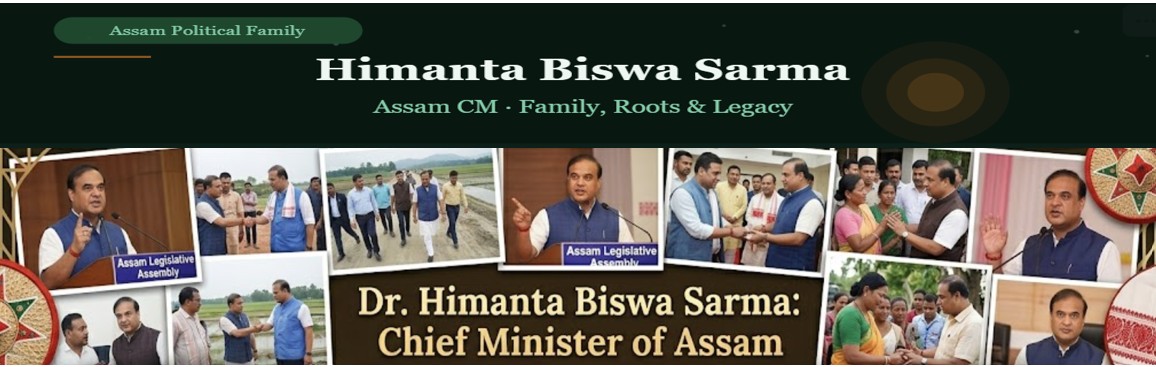
Behind every great leader is a family story that shaped who they became. In the case of Himanta Biswa Sarma — the 15th Chief Minister of Assam, one of India's most dynamic and consequential regional politicians — that story begins in the literary households of Assam, winds through the corridors of Cotton College, and ultimately arrives at the helm of a state of 35 million people. His is a tale of roots, resilience, ambition, and a family that has walked alongside him every step of the way.
Early Life and Family Origins
Dr Himanta Biswa Sarma was born in Jorhat on 1 February 1969, to Kailash Nath Sarma and Mrinalini Devi. His father was a well-known poet and novelist of Assam, and his mother is a literary personality actively associated with the Assam Sahitya Sabha. OneIndia
This cultural inheritance is no small detail. Growing up in a home where literature, language, and ideas were central to daily life gave the young Himanta a foundation that would serve him far beyond the classroom — an ability to communicate, persuade, and connect with people that would become one of his defining political gifts.
He belongs to an Assamese family which traces its origins to Latima in Nalbari district. Wikipedia The Sarma family later relocated to Guwahati, where Himanta would spend his formative years. The family moved to the Ulubari, Guwahati area, and Himanta grew up alongside six siblings, close-knit household that instilled in him the value of family bonds, collective identity, and the Assamese cultural pride that would later define his political persona.
Education: Building a Foundation
Himanta's educational journey reflects both discipline and ambition — qualities that would carry him from a student debater to the state's highest office.
He completed his schooling at Kamrup Academy School, Guwahati in 1985, and went on to Cotton College, Guwahati, to pursue his Bachelor of Arts in Political Science in 1990. He then completed his Master of Arts in Political Science from the same college in 1992. WikiBio
Cotton College — now Cotton University — is more than just an institution in Assam's capital. It is the intellectual heartbeat of Assamese society, a place where generations of the state's leaders, writers, and thinkers have been shaped. For Himanta, it was also where he would meet the woman who would become his life partner.
While in college, Himanta was skilled at debates and often participated in debate competitions. He received the best debater award in the Manik Chandra Baruah Memorial debating competition at his college. StarsUnfolded His student leadership was equally strong — he served as the General Secretary of his college's student union from 1991 to 1992. WikiBio
After completing his postgraduate studies, Himanta pursued law. He obtained a Bachelor of Laws from Government Law College, Guwahati, and practised law at the Gauhati High Court from 1996 to 2001. He later completed a PhD in Political Science from Gauhati University in 2006, focusing on the North Eastern Council.
The combination of political science, law, and a doctoral degree gave him an intellectual profile rare among politicians — one that blended street-level political instinct with rigorous academic training.
A Childhood on Screen: The Child Actor
One of the lesser-known and charming facts about Himanta Biswa Sarma's early life is his brief career as a child artist. Biswa worked as a child artist in the Assamese film "Kokadeuta, Nati aru Hati" in 1984. StarsUnfolded This early exposure to storytelling and public performance — however brief — reflects a personality comfortable in front of an audience, at ease with communication, and rooted in Assamese cultural life.
His Wife: Riniki Bhuyan Sarma
The love story between Himanta Biswa Sarma and Riniki Bhuyan is one that began in the classrooms of Cotton College — and grew into one of Assam's most prominent partnerships, both personal and professional.
Riniki Bhuyan Sarma was born on 31 July 1973 in Guwahati. She comes from a notable family, with her father, Jadav Chandra Bhuyan, being a well-known industrialist. Riniki's early education took place in Guwahati, where she attended St. Mary's High School before moving on to Cotton College, where she graduated with a degree in Political Science. Following her undergraduate studies, she pursued a law degree at Government Law College in Guwahati. Wikipedia
Their shared academic background — both studied Political Science and Law at the same institutions — was more than coincidence. It reflects a genuine meeting of minds and shared ambitions. They met as students while studying at Cotton College, and Himanta shared his ambition of becoming Chief Minister with her. Wikipedia
During an interview, Riniki shared that when she asked Himanta what she should tell her mother he did for a living, he replied: "Tell your mother, I will be the Chief Minister one day." StarsUnfolded It was a declaration that proved to be not mere youthful bravado, but a genuinely held conviction — one that took two decades and a dramatic political journey to fulfil.
They married on June 7, 2001.
Riniki has gone on to build a formidable career of her own. She is the Chairperson and Managing Director of Pride East Entertainments, the parent company of several Assamese channels — including two news channels, News Live and North East Live, three entertainment channels, and the Assamese newspaper Niyamiya Barta. She is also the proprietor of JCB Industries, makers of the Aadya brand of sanitary products. Wikipedia
Far from being simply a political spouse, Riniki Bhuyan Sarma is a significant figure in Assam's media and business landscape in her own right — a businesswoman who has built a media house that shapes public discourse across the Northeast.
Their Children: The Next Generation
Himanta and Riniki have two children together: a son, Nandil Biswa Sarma, and a daughter, Sukanya Sarma. Nandil attended The Doon School, and Sukanya attended Mayo College Girls School. Wikipedia
Both The Doon School and Mayo College Girls School are among India's most prestigious residential schools — institutions that have educated generations of India's political, business, and intellectual elite. The choice of these schools reflects the family's investment in education, a value Himanta has championed throughout his political career.
Nandil and Sukanya represent the next generation of the Sarma family — young people growing up at the intersection of politics, media, and Assamese cultural identity.
The Sarma Family Tree at a Glance
Parents
- Father: Kailash Nath Sarma — poet and novelist, a prominent literary figure of Assam
- Mother: Mrinalini Devi — literary personality and active member of the Assam Sahitya Sabha
Himanta Biswa Sarma
- Born: 1 February 1969, Jorhat, Assam
- Family roots: Latima, Nalbari district
- Grew up in Ulubari, Guwahati
- One of seven siblings
Wife: Riniki Bhuyan Sarma
- Born: 31 July 1973, Guwahati
- Father: Jadav Chandra Bhuyan, industrialist
- Education: Cotton College (Political Science), Government Law College
- Career: MD, Pride East Entertainments; proprietor, JCB Industries
Children
- Son: Nandil Biswa Sarma (attended The Doon School, Dehradun)
- Daughter: Sukanya Sarma (attended Mayo College Girls School, Ajmer)
Political Career: From Student Leader to Chief Minister
Himanta Biswa Sarma is the 15th Chief Minister of Assam, in office since 2021. He has been a member of the Assam Legislative Assembly for five consecutive terms — 2001, 2006, 2011, 2016, and 2021 — all from the Jalukbari constituency. Encyclopedia Britannica
His political journey covers two very different chapters. He began as a Congress leader, rising to hold some of the state's most important ministerial portfolios. From 2002 to 2014, he served as Minister of State and Cabinet Minister for Agriculture, Planning and Development, Finance, Health, and Education. WikiBio
His time as Health Minister left a particularly significant mark. While serving as Education Minister of Assam, Biswa got medical colleges built in Jorhat, Barpeta, and Tezpur. It was during his tenure that the interview system was abolished and for the first time, 50,000 teachers were appointed through the Teachers Eligibility Test — a transparent process that ended a major source of corruption in appointments. StarsUnfolded
Himanta Biswa Sarma left the Indian National Congress in 2015 primarily because of conflicts over leadership succession and dissatisfaction with what he referred to as the party's "family-centric politics." Encyclopedia Britannica He joined the Bharatiya Janata Party on 23 August 2015, and quickly became one of the BJP's most effective strategists in Northeast India.
As the state's health minister when the COVID-19 pandemic broke out, Sarma's "Prepare, prepare, and overprepare" mantra and swift response — setting up treatment centres in each district before the first case was detected in the state — gained wide recognition. Encyclopedia Britannica
Popularly addressed as "Mama" — the Assamese word for maternal uncle — especially by the state's younger population, Sarma is widely regarded as an accessible leader and a political strategist. Encyclopedia Britannica The nickname reflects something important about how he is perceived: not as a remote, formal authority, but as a familiar, approachable figure — almost a family member to the people of Assam.
Beyond Politics: The Many Dimensions of Himanta
Himanta Biswa Sarma's public identity extends well beyond politics into sports, literature, and culture — dimensions of his personality shaped directly by his family upbringing.
He was elected as the President of the Badminton Association of India on 23 April 2017, and has also served as President and Vice-President of the Assam Cricket Association. StarsUnfolded
His literary side — inherited from his father the poet and his mother the Sahitya Sabha member — has also found public expression. He has written three books in Assamese: Samagata Samay, Bhinna Samay Abhinna Mat, and Eta Saponar Pam Khedi. He has also translated Amit Shah's biography into Assamese. StarsUnfolded
These are not the typical pursuits of a purely transactional politician. They reveal a man who genuinely inhabits Assamese cultural life — not just as a political leader but as a participant in the literary and intellectual traditions his parents modelled for him from childhood.
A Family Rooted in Assamese Identity
What stands out most clearly about the Sarma family story is how profoundly rooted it is in Assamese identity — in language, literature, culture, and community. From Kailash Nath Sarma's poetry to Riniki Bhuyan Sarma's Assamese media empire, and from Himanta's student debates in Cotton College to his championing of Assamese culture as Chief Minister, this is a family whose public life is an extension of deeply held private values.
The choice of the Sarma children's schools, the founding of a major Assamese media house, the translation of political biographies into Assamese, the doctoral research on the Northeast — all of these speak of a family that takes its identity seriously and wants that identity to endure.
It is a reminder that the families behind public figures are not just biographical footnotes. They are the source code — the place where values, ambitions, and character are first written.
What the Sarma Family Story Teaches Us
The Himanta Biswa Sarma family story is a compelling example of how deeply a family's cultural, intellectual, and values heritage shapes the individuals who grow from it. A poet father and a literary mother raised a son who became one of India's sharpest political communicators. A college romance between two students of Political Science became a life partnership that spans government, business, and media. And two children, raised in a household of ambition and public service, are now carrying that legacy into the next generation.
For those interested in family history and genealogy, the Sarma family is a vivid reminder that understanding a person fully means understanding the family they came from — and the roots that hold them to the ground.
Want to document your own family's story, heritage, and values for future generations? Start building your family tree on our platform — where every family history, from Nalbari to Jorhat, deserves to be remembered.
👉 Start building your family legacy today with Family Root App
- Android: Family Root App on Google Play
- iOS: Family Root App on Apple Store
📜 Disclaimer
The family tree and biographical information provided in this article are based on publicly available sources and records. While we strive for accuracy, we do not guarantee the completeness or authenticity of the data. This content is intended for educational and informational purposes only and does not aim to infringe on any individual's privacy or personal rights. If you believe any information is incorrect or wish to request edits or removal, please contact us at Info@familyrootapp.com.