
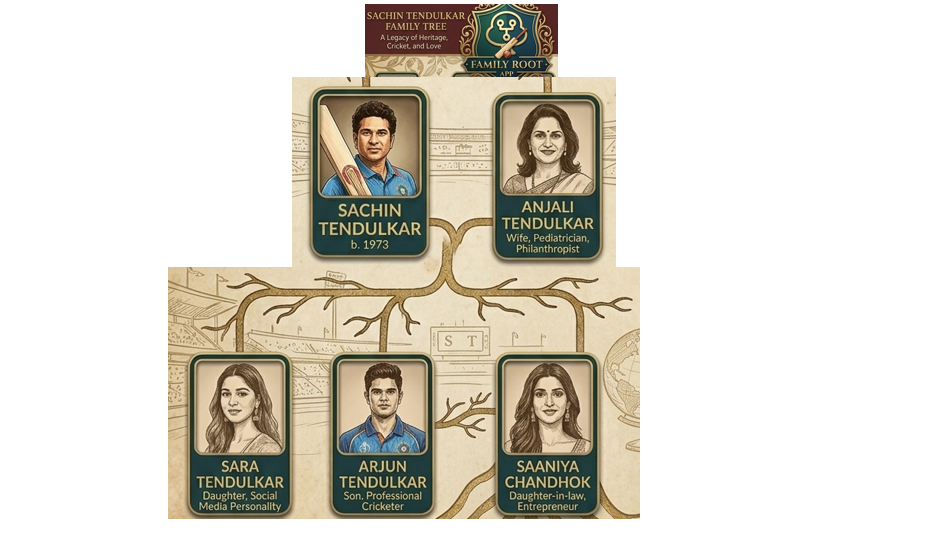
There are cricketers, and then there is Sachin Tendulkar. For over two decades, the boy from Bandra carried the hopes of a billion people on his narrow shoulders with a grace that made it look easy — though nothing about it was. Behind every one of his 100 international centuries, behind the composure and the craft and the genius, lay a family story as rich and layered as Marathi literature itself.
The Tendulkar family is not a dynasty of cricketers. It is a dynasty of quiet achievers — a poet-professor father who gave his son a name borrowed from music, a mother who worked in insurance even when the whole nation knew her son, a brother who gave up his own ambitions to serve a sibling's dream, and a wife who surrendered a medical career so that Sachin could be Sachin.
This is the story of that family — across three generations, from the Konkan coast of Alibag to the Wankhede Stadium farewell that moved an entire nation to tears.
The Family's Roots: Alibag, the Konkan Coast, and a Literary Household
The Tendulkar family belongs to the Rajapur Saraswat Brahmin community — one of Maharashtra's storied Brahmin sub-groups, with deep historical roots in the Konkan coast of western India. Brainly
The family's modern story begins in Alibag, the coastal town in Raigad district about 50 kilometres south of Mumbai, where Sachin's father Ramesh was born and raised. It was from these Konkan roots — a land of the sea, literature, and the Marathi cultural tradition — that the Tendulkar family drew its identity.
His Father: Ramesh Tendulkar — The Poet Who Named a Legend
Of all the figures in the Sachin Tendulkar family story, none is more fascinating — or more underappreciated — than his father, Ramesh Tendulkar (18 December 1930 – 19 May 1999).
Ramesh Tendulkar was not a cricket man. He was a Marathi-language novelist, poet, and literary critic — a man of words, not of willow — whose contributions to Maharashtra's literary culture were significant long before his son became India's greatest cricketer. He completed his primary and secondary education at Konkan Education Society in Alibag, then moved to Mumbai for higher education, and later joined Kirti M. Doongursee College (also known as Kirti College), Prabhadevi, as a professor in the 1960s. Wikipedia — Ramesh Tendulkar
He was a major functionary of the Mumbai Marathi Granth Sangrahalaya's Marathi Sanshodhan Mandal — the research organisation of one of Mumbai's oldest and most respected Marathi libraries, in Dadar East. His friends and colleagues included Maharashtra's most prominent literary and political figures. He published multiple collections of poetry and literary criticism. He wrote about the first poetry recital of Vinda Karandikar — the Jnanpith Award winner — back in 1950, decades before the fame arrived. He was, in short, a serious man of serious letters. Countercurrents
Ramesh came up the hard way — walking 8 kilometres to school and 8 kilometres back in Alibag, supporting a large joint family, working while going to college, studying quietly at home facing the wall in a two-room house in Dadar. His son, in a memorial address delivered at the Granth Sangrahalaya on his father's 25th death anniversary in 2024, recalled that Ramesh "would always make the postman, a watchman or a worker sit on the sofa, and talked with them softly" — a man whose intellectual distinction never translated into personal arrogance. Countercurrents
Ramesh lived in the Sahitya Sahawas Cooperative Housing Society in Bandra East — a housing colony built for writers, where Maharashtra's literary community gathered, debated, and created. It was in this household, surrounded by books and literary conversations, that Sachin Tendulkar grew up.
And the name "Sachin" itself came from Ramesh's love of music. He named his son after his favourite music director, Sachin Dev Burman — the legendary Bengali-origin composer whose songs defined Hindi cinema for a generation. A poet naming his son after a musician. It is, in its own small way, a perfect illustration of the Tendulkar household's sensibility.
Ramesh was an open-minded, loving father who never once stood in his son's way. When Sachin wanted to change schools to pursue cricket at the better-equipped Sharadashram Vidyamandir, Ramesh allowed it without hesitation. When the teenage Sachin's cricket talent became undeniable, he encouraged it fully. He threw an "open house" at Sahitya Sahawas — welcoming teammates, coaches, and fans with characteristic warmth. Countercurrents
Then came the day in May 1999 that broke India's heart.
On 19 May 1999, Ramesh Tendulkar suffered a heart attack and passed away at the age of 68. Sachin was in England, playing for India in the 1999 Cricket World Cup. He flew back to India to attend his father's last rites — missing the match against Zimbabwe. And then, just days later, he returned to the World Cup. Wikipedia
In his very next innings — against Kenya in Bristol — Sachin Tendulkar walked to the crease carrying the grief of a son who had just buried his father, and scored 140 not out off 101 balls. He looked skyward when he reached his century. He had dedicated it to his father. It remains one of the most emotionally charged innings in cricket history.
His Mother: Rajni Tendulkar — The Woman Who Kept Working
Rajni Tendulkar is Sachin's mother and Ramesh's second wife — and her story carries its own quiet dignity.
Ramesh Tendulkar had been married before. His first wife — the mother of his three older children Nitin, Ajit, and Savita — passed away after the birth of her third child. In a tradition that was not uncommon in that era, Ramesh married Rajni, the younger sister of his deceased first wife. From this second marriage came the fourth child: Sachin. CricTracker
Rajni was a LIC (Life Insurance Corporation) agent, working in the Foreign Department of the LIC's Santacruz branch in Mumbai. She continued working throughout her son's entire cricket career — a quiet statement of independence from a woman who could easily have rested in the comfort of her son's extraordinary fame. She worked until her retirement, even through a period between 1992 and 1994 when she faced difficulty in walking. CricTracker
She was Sachin's quiet emotional pillar. It was Rajni who, after Ramesh's sudden death in 1999, convinced her grieving son to return to England and play on in the World Cup — telling him that his father would have wanted him to continue. That counsel, given in the depths of personal grief, changed the course of the tournament and produced one of cricket's most legendary innings. SportsCraazy
In 2013, she attended her son's 200th and final Test match at Wankhede Stadium — watching from the stands as 33,000 people wept and roared and chanted "Sachin! Sachin!" for the last time. She had watched him on television for most of his career, rarely attending matches, preserving a private dignity even as her son became the most famous sportsman in the country.
Rajni Tendulkar passed away in 2024 at the age of 87 — having lived long enough to see her youngest son receive the Bharat Ratna, India's highest civilian honour. JeetwinSports
Elder Brother: Nitin Tendulkar — The Literary One
Nitin Tendulkar is the eldest of the four Tendulkar siblings — Ramesh's first child by his first wife, and therefore Sachin's elder half-brother. He is approximately 15 years older than Sachin.
Nitin followed his father's literary path rather than cricket — he is known to have written poetry, carrying on the Tendulkar family's Marathi literary tradition. He worked for Air India for most of his career. He maintains an extremely low public profile and is rarely seen in media appearances. He was present at the 25th death anniversary memorial for Ramesh Tendulkar in 2024, where Sachin recalled childhood memories of their father. CricTracker
Elder Brother: Ajit Tendulkar — The Man Who Made It Happen
If Ramesh Tendulkar gave Sachin his name and his values, it is Ajit Tendulkar who gave him cricket.
Ajit is approximately 15 years older than Sachin and is Ramesh's second child by his first wife. He played cricket himself in Mumbai's Kanga Cricket League — a beloved Mumbai institution where the city's club cricketers play in the monsoon rains. He had talent, but it was his younger half-brother whose talent was something else entirely. Wikipedia
The young Sachin was, by his own admission, a bully in childhood — picking fights, full of energy and mischief that needed a direction. It was Ajit who spotted something extraordinary in his youngest sibling and took action. In 1984, he brought the 11-year-old Sachin to coach Ramakant Achrekar at Shivaji Park — one of Mumbai's most legendary cricket grounds. PlanetSpark
The first meeting did not go well. Achrekar was not immediately impressed. The young Sachin froze under scrutiny and could not show his best. It was Ajit's conviction — his insistence to the coach that the boy deserved another chance, that there was something special here that the first tryout had not revealed — that changed everything. Achrekar agreed to see Sachin again, this time without the boy knowing he was being watched. Unobserved, Sachin batted freely — and Achrekar immediately recognised the genius. CricTracker
Ajit devoted years of his own life to Sachin's cricket development — accompanying him to practice sessions, travelling with him, advocating for him, and providing the detailed analytical feedback that polished the raw talent into world-class craft. It is no exaggeration to say that without Ajit Tendulkar's vision and sacrifice, the Sachin Tendulkar the world came to worship might never have emerged.
Ajit is 15 years older than Sachin, studied at Mumbai's Ruia College, and has maintained a purposefully low profile throughout his brother's career — satisfied, it seems, with the knowledge of what he helped build. Sportskeeda
Elder Sister: Savita Tendulkar — The First Bat
Savita Tendulkar is Sachin's elder half-sister — Ramesh's third child by his first wife, a few years older than Sachin.
In the Tendulkar family story, Savita occupies a place of great warmth and simplicity. She is a homemaker who has always stayed close to Sachin and the family, celebrating every festival together. Sachin posts photos with her each year on Rakshabandhan — the festival of siblings — a regularity that speaks to the bond they share. Sportskeeda
And there is one detail about Savita that every cricket fan should know: she gifted Sachin his first cricket bat. The God of Cricket received his first willow from his sister. CricTracker
His Wife: Anjali Tendulkar — The Doctor Who Chose a Different Career
The love story of Sachin and Anjali Tendulkar is one of Indian sport's most beloved romances — and one of its most quietly extraordinary.
Anjali Mehta was born on 10 November 1967 in Mumbai — making her six years older than Sachin. She is from a prominent Gujarati business family: her father, Anand Mehta, is a well-known industrialist, and her mother, Annabel Mehta, is the founder of Apnalaya, a respected NGO working with Mumbai's underprivileged communities. SportsCraazy
Anjali was a brilliant medical student. She graduated as a gold medallist from Grant Medical College, Mumbai and became a paediatrician — a doctor who devoted herself to the health of children. She was building a distinguished medical career when cricket intervened.
They met for the first time in 1990 at Mumbai International Airport. Sachin had just returned from an overseas tour. Anjali was at the airport to receive her mother. A common friend introduced them. At 17, Sachin had already made his international debut and was beginning to be recognised — but Anjali was entirely unaware of who he was. Her very ignorance of his celebrity, she later said, was what sparked her genuine interest in him as a person. She went home and learnt everything she could about cricket. CricTracker
They dated for five years — navigating the extraordinary pressures of a relationship in which one partner was rapidly becoming the most famous sportsman in India — before marrying on 24 May 1995 in a small, private ceremony in Worli, Mumbai, attended only by close family and friends. Wikipedia
After her marriage, Anjali made a decision that she has never publicly regretted: she set aside her medical practice to focus on raising their family and providing Sachin with the stable, loving home he needed to sustain a career of extraordinary length and pressure. In a country where celebrity wives are often viewed through a narrow lens, Anjali Tendulkar has always been understood as a full partner in her husband's achievement — the person who made his career possible by absorbing its costs.
She is today the co-founder of SRT Sports Management Private Limited and the Sachin Tendulkar Foundation, bringing her intelligence and commitment to bear on the family's philanthropic and business endeavours. CricTracker
Their Children: Sara and Arjun
Sachin and Anjali have two children who have grown up in the extraordinary circumstances of being the son and daughter of India's most worshipped sportsman.
Sara Tendulkar was born on 12 October 1997 — Sachin's first child and, by all accounts, a deeply personal anchor for him throughout the latter years of his career. She completed her schooling at the prestigious Dhirubhai Ambani International School in Mumbai, and then pursued medicine at the University College of London — following in her mother's footsteps as a doctor. She remains largely private but has a warm social media presence and participates in the Sachin Tendulkar Foundation's charitable work in health, education, and sports. Sportskeeda
Arjun Tendulkar was born on 24 September 1999 at Breach Candy Hospital, Mumbai — born into the same year his grandfather Ramesh passed away. He is a left-arm fast bowler who has chosen to follow his father onto the cricket field, playing domestic cricket for Goa and featuring in the IPL. Sachin has been careful not to push Arjun publicly, allowing him to find his own path — though the weight of his father's name is a companion that no coaching can prepare a young cricketer for. CricketAddictor
The Sachin Tendulkar Family Tree at a Glance
Community
- Rajapur Saraswat Brahmin, Maharashtra
- Family roots: Alibag, Konkan coast, Raigad district, Maharashtra
Father
- Ramesh Tendulkar (18 December 1930 – 19 May 1999) — Marathi novelist, poet and literary critic; professor at Kirti College, Mumbai; born Alibag; lived in Sahitya Sahawas, Bandra East; named Sachin after music director Sachin Dev Burman; died of heart attack during 1999 World Cup
Mother
- Rajni Tendulkar — second wife of Ramesh (sister of his deceased first wife); LIC agent (Foreign Department, Santacruz branch); worked until retirement despite son's fame; passed away 2024 aged 87
Half-Siblings (children of Ramesh & his first wife)
- Elder brother: Nitin Tendulkar — poet; Air India employee; maintains private life
- Elder brother: Ajit Tendulkar — 15 years older than Sachin; played Kanga League cricket; took Sachin to coach Ramakant Achrekar; devoted years to Sachin's development
- Elder sister: Savita Tendulkar — homemaker; gifted Sachin his first cricket bat; close bond with Sachin throughout life
Sachin Tendulkar
- Born: 24 April 1973, Nirmal Nursing Home, Dadar, Bombay (now Mumbai)
- Grew up: Sahitya Sahawas, Bandra East, Mumbai
- School: Sharadashram Vidyamandir High School, Shivaji Park
- Coach: Ramakant Achrekar (from age 11)
Wife: Anjali Tendulkar (née Mehta)
- Born: 10 November 1967, Mumbai (6 years older than Sachin)
- Father: Anand Mehta — Gujarati industrialist
- Mother: Annabel Mehta — founder of NGO Apnalaya
- Education: Grant Medical College, Mumbai (gold medallist); qualified paediatrician
- Met Sachin: 1990, Mumbai International Airport
- Married: 24 May 1995, Worli, Mumbai
- Career today: Co-founder, SRT Sports Management Pvt Ltd & Sachin Tendulkar Foundation
Children
- Daughter: Sara Tendulkar (born 12 October 1997, Mumbai) — medical graduate, University College London; philanthropist; active in Sachin Tendulkar Foundation
- Son: Arjun Tendulkar (born 24 September 1999, Breach Candy Hospital, Mumbai) — left-arm fast bowler; plays domestic cricket for Goa; IPL career
The Century Dedicated to a Father
No retelling of the Tendulkar family story is complete without returning to the afternoon of 23 May 1999, in Bristol, England.
Four days after burying his father in Mumbai, Sachin Tendulkar walked to the crease at the County Ground in Bristol for India's World Cup match against Kenya. He was 25 years old, carrying a grief he had not been able to fully sit with. He batted for 101 balls and scored 140 not out — one of the most controlled and emotionally charged innings of his career.
When he reached his century, he looked upward. He pointed to the sky. Every person in every cricket-watching household in India knew what that gesture meant.
In his retirement speech at Wankhede in 2013 — the speech that made an entire nation cry — Sachin spoke of his father: "I miss you, Baba." Fourteen years after the Bristol century. Still looking skyward.
This is what a family means to a cricketer. Not just support — but the deepest reasons for playing.
What the Tendulkar Family Story Teaches Us
The Sachin Tendulkar family story is, above all, a story about what families make possible when they simply believe in someone.
A poet-father who built an intellectual household and never once questioned his son's different path. A mother who worked in insurance while her son scored hundreds that stopped India in its tracks. A brother who gave up his own ambitions so that a sibling's genius could flourish. A sister who gave the first bat. A wife who gave a medical career.
These are not the stories that make headlines. But they are the stories that make champions.
For those passionate about family history and genealogy, the Tendulkar family tree is a reminder that every extraordinary achievement has an extraordinary family story behind it — and that every family story is worth preserving.
Inspired by the Tendulkar family story? Every family — whatever its heritage, wherever its roots — has a history worth preserving for generations to come. Start building your family tree today with Family Root App.
👉 Start building your family legacy today with Family Root App
- Android: Family Root App on Google Play
- iOS: Family Root App on Apple Store
📜 Disclaimer The family tree and biographical information provided in this article are based on publicly available sources and records. While we strive for accuracy, we do not guarantee the completeness or authenticity of all data. This content is intended for educational and informational purposes only and does not aim to infringe on any individual's privacy or personal rights. If you believe any information is incorrect or wish to request edits or removal, please contact us at Info@familyrootapp.com.